Retirement Calculator – Estimate Your Future Retirement Savings
Planning for retirement is one of the most important financial decisions you’ll ever make. Whether you’re just starting your career or approaching retirement age, understanding how much you’ll need to save can help you achieve long-term financial security.
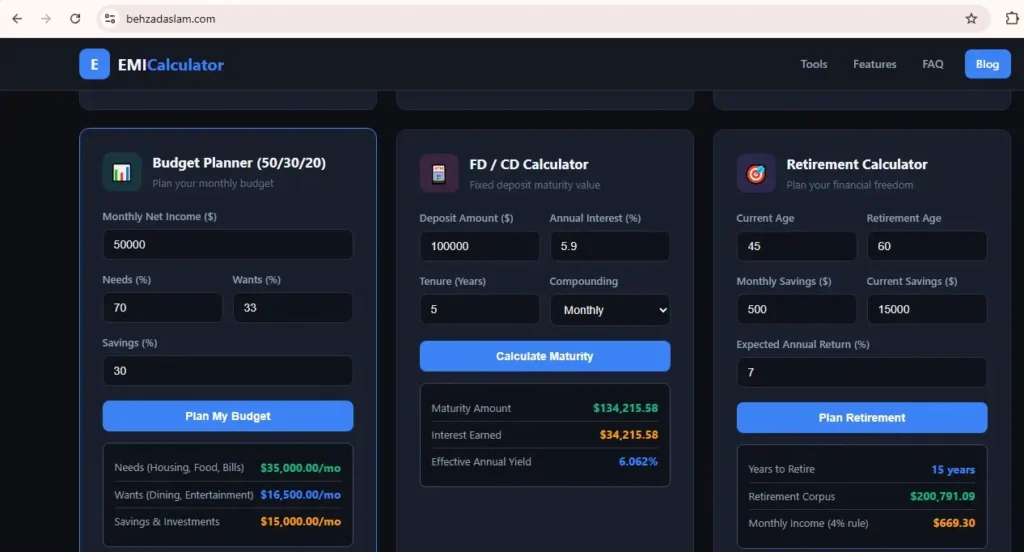
Our free Retirement Calculator helps you estimate your future retirement savings based on your current age, retirement age, existing savings, monthly contributions, expected annual return, and inflation assumptions. Within seconds, you’ll receive a clear projection of your retirement fund and whether you’re on track to meet your financial goals.
Unlike many retirement planning tools, our calculator is completely free, mobile-friendly, and designed for individuals, families, and professionals who want to make informed financial decisions without sharing personal information.
Why Use Our Retirement Calculator?
Planning for retirement without accurate estimates can lead to financial uncertainty. Our Retirement Calculator helps you make smarter long-term decisions by providing realistic projections based on your savings habits and investment growth.
Benefits
Estimate Future Retirement Savings
Calculate Monthly Retirement Contributions
Understand Compound Growth
Plan Long-Term Financial Goals
Compare Different Retirement Ages
Adjust Investment Return Assumptions
Estimate Retirement Income
Free & Instant Results
Start Planning Your Retirement Today
Enter the following information:
- Current Age
- Planned Retirement Age
- Current Retirement Savings
- Monthly Contribution
- Expected Annual Return (%)
- Expected Inflation Rate (%)
Click Calculate Retirement Savings to instantly view:
- Estimated Retirement Fund
- Total Contributions
- Total Investment Growth
- Inflation-Adjusted Value
- Retirement Summary
Retirement Calculator Tool
Enter your current age, retirement age, existing savings, monthly contribution, expected annual return, and inflation rate to estimate how much money you could have when you retire.
Retirement Formula
Formula Explanation
| Symbol | Meaning |
| FV | Future Retirement Value |
| P | Current Retirement Savings |
| PMT | Monthly Contribution |
| r | Monthly Rate of Return |
| n | Total Number of Months |
Start Building Your Retirement Plan Today
Every year you delay saving for retirement could reduce your future financial security. Use our free Retirement Calculator to estimate your retirement savings and make confident financial decisions for the years ahead.
Why Trust BehzadAslam.com?
At BehzadAslam.com, we build practical financial calculators and educational resources to help individuals make smarter money decisions. Every calculator is designed using established financial formulas and is intended for educational and planning purposes.
What Is Retirement Planning?
Retirement planning is the process of preparing financially for the years when you stop working or significantly reduce your income from employment. Instead of relying solely on government benefits or pensions, a well-designed retirement plan helps you build enough savings and investments to maintain your preferred lifestyle after retirement.
The earlier you begin saving, the more time your investments have to grow through compound interest. Even small monthly contributions can become substantial over several decades. Retirement planning is not only about accumulating wealth—it is about creating financial independence and reducing stress later in life.
Whether your goal is to travel, spend more time with family, pursue hobbies, or simply enjoy financial security, a retirement plan gives you greater confidence about the future.
Why Retirement Planning Matters
Many people underestimate how much money they will need after retirement. Living expenses, healthcare costs, inflation, taxes, and unexpected emergencies can quickly reduce retirement savings if proper planning is not done.
A retirement plan helps you:
- Estimate your future financial needs.
- Build long-term wealth through regular investing.
- Reduce dependence on debt during retirement.
- Prepare for inflation.
- Create stable retirement income.
- Achieve greater financial independence.
Planning today gives you more flexibility tomorrow.
How a Retirement Calculator Works
A Retirement Calculator estimates how much money you could accumulate before retirement based on several financial factors.
The calculator generally considers:
- Current age
- Planned retirement age
- Current retirement savings
- Monthly investment contribution
- Expected annual investment return
- Inflation rate
Using these values, the calculator estimates:
- Future retirement balance
- Total contributions
- Investment growth
- Inflation-adjusted purchasing power
Instead of making complicated calculations manually, the tool instantly provides realistic projections that help you evaluate different retirement strategies.
Step-by-Step Retirement Planning Example
Imagine the following scenario:
| Financial Information | Value |
| Current Age | 30 Years |
| Retirement Age | 65 Years |
| Current Savings | $20,000 |
| Monthly Contribution | $500 |
| Expected Annual Return | 8% |
| Inflation Rate | 2.5% |
After entering these values into the calculator, the estimated retirement savings could exceed $1 million, depending on market performance and contribution consistency.
This example highlights how starting early allows investment growth to work in your favor over several decades.
How Compound Interest Helps Retirement Savings
Compound interest is one of the most powerful tools for long-term wealth creation. Instead of earning returns only on your initial investment, you also earn returns on previous investment gains.
For retirement planning, this means your money continues growing year after year, even if you stop increasing your monthly contributions.
For example:
- Investing $500 per month for 35 years typically produces significantly higher retirement savings than investing $1,000 per month for only 15 years.
Time often matters more than contribution size because compound growth becomes stronger over longer periods.
This is why financial advisors frequently recommend starting retirement investing as early as possible.
Understanding the 4% Safe Withdrawal Rule
One of the most widely discussed retirement planning guidelines is the 4% Rule.
According to this guideline, retirees may be able to withdraw approximately 4% of their retirement portfolio annually while reducing the risk of running out of money over a long retirement.
Example:
| Retirement Savings | Approximate Annual Withdrawal |
| $500,000 | $20,000 |
| $750,000 | $30,000 |
| $1,000,000 | $40,000 |
| $1,500,000 | $60,000 |
While the 4% Rule is a useful starting point, actual withdrawal rates depend on investment performance, taxes, inflation, healthcare costs, and personal spending habits.
Factors That Affect Retirement Savings
Several variables influence how much money you will have when you retire.
Starting Age
Beginning earlier allows compound interest to work for a longer period.
Monthly Contributions
Increasing monthly investments generally leads to larger retirement balances.
Investment Returns
Higher long-term returns can significantly increase retirement savings, although they usually involve greater investment risk.
Inflation
Inflation reduces purchasing power over time. A retirement plan should account for rising living expenses.
Retirement Age
Working a few additional years can increase savings while reducing the number of retirement years your portfolio needs to support.
Lifestyle Choices
Expected retirement spending directly affects the amount of savings required.
Common Retirement Planning Mistakes
Avoiding common mistakes can greatly improve your long-term financial security.
Starting Too Late
Waiting even ten years can dramatically reduce the benefits of compound growth.
Saving Too Little
Contributing only the minimum amount may not be sufficient for future living expenses.
Ignoring Inflation
Many people calculate today’s expenses without considering future cost increases.
Investing Too Conservatively
Keeping retirement savings entirely in low-return investments may not provide enough long-term growth.
Not Reviewing Your Plan
Retirement plans should be reviewed regularly as income, expenses, investment performance, and life goals change.
Depending on One Income Source
Diversifying retirement income through savings, investments, employer retirement plans, and other assets can reduce financial risk.
Smart Retirement Planning Tips
Following practical financial habits can improve your retirement outlook.
- Begin saving as early as possible.
- Increase contributions whenever your income grows.
- Reinvest investment earnings whenever possible.
- Maintain an emergency fund separate from retirement savings.
- Diversify your investment portfolio.
- Review your retirement plan annually.
- Avoid withdrawing retirement funds prematurely.
- Keep investment costs and unnecessary fees as low as possible.
- Continue learning about long-term investing and financial planning.
Small, consistent improvements made over many years often produce better results than attempting to make large contributions later in life.Following practical financial habits can improve your retirement outlook.
- Begin saving as early as possible.
- Increase contributions whenever your income grows.
- Reinvest investment earnings whenever possible.
- Maintain an emergency fund separate from retirement savings.
- Diversify your investment portfolio.
- Review your retirement plan annually.
- Avoid withdrawing retirement funds prematurely.
- Keep investment costs and unnecessary fees as low as possible.
- Continue learning about long-term investing and financial planning.
Small, consistent improvements made over many years often produce better results than attempting to make large contributions later in life.
Early Saving vs Late Saving Comparison
| Comparison | Early Saver | Late Saver |
| Starting Age | 25 | 40 |
| Monthly Investment | $400 | $400 |
| Retirement Age | 65 | 65 |
| Investment Period | 40 Years | 25 Years |
| Compound Growth | Very High | Moderate |
| Estimated Retirement Fund | Significantly Larger | Considerably Lower |
This comparison demonstrates that time is one of the most valuable assets in retirement planning.
Real-Life USA Retirement Scenario
Consider Sarah, a 32-year-old marketing professional living in Texas. She currently has $18,000 in retirement savings and contributes $550 each month to her retirement account. By using our Retirement Calculator, she tested several contribution scenarios and realized that increasing her monthly savings by just $100 could substantially improve her projected retirement balance by age 65.
Instead of waiting until later in life to save more, Sarah adjusted her monthly budget and increased her retirement contribution immediately. This simple change demonstrates how small, consistent decisions made today can have a meaningful impact on long-term financial security.
Why Trust Our Retirement Calculator?
Planning for retirement is a long-term financial decision that deserves reliable information and accurate calculations. At BehzadAslam.com, our Retirement Calculator is built using established financial formulas commonly used in retirement planning. While no calculator can predict future market performance with certainty, our tool provides realistic projections to help you make informed decisions.
We believe financial tools should be simple, transparent, and accessible to everyone. That’s why our calculator works instantly in your browser without requiring registration or collecting personal financial information.
Why Users Trust BehzadAslam.com
- Educational, easy-to-understand financial content.
- Practical calculators built with standard financial formulas.
- Mobile-friendly and fast-loading tools.
- No account registration required.
- Free access to all financial calculators.
- Regularly updated content to reflect current financial best practices.
Financial Planning for Retirement
A successful retirement plan involves more than simply saving money. It requires balancing current financial responsibilities with long-term goals while adapting to changes in income, inflation, and personal circumstances.
A few habits can significantly improve your retirement readiness:
- Review your retirement goals every year.
- Increase retirement contributions whenever your salary increases.
- Avoid withdrawing retirement savings early unless absolutely necessary.
- Diversify your investments according to your risk tolerance.
- Build an emergency fund separate from retirement savings.
- Monitor inflation and healthcare costs as part of your long-term planning.
Consistent financial discipline over many years often has a greater impact than trying to make large contributions later in life.
Frequently Asked Questions (FAQ)
What is a Retirement Calculator?
A Retirement Calculator estimates how much money you may accumulate before retirement based on your current savings, monthly contributions, expected investment returns, and retirement age.
Is this Retirement Calculator free?
Yes. Our calculator is completely free to use and does not require registration or payment.
How accurate are the results?
The estimates are based on the information you provide and standard financial formulas. Actual investment performance and future market conditions may vary.
Does the calculator consider inflation?
Yes. You can enter an expected inflation rate to better estimate the future purchasing power of your retirement savings.What annual return should I use?
Many long-term diversified investment portfolios historically average around 6–10% annually, but future returns are never guaranteed. Choose a rate that matches your own investment assumptions.
How often should I review my retirement plan?
Review your retirement strategy at least once a year or whenever major financial changes occur, such as a salary increase, career change, or significant life event.
Can I use this calculator for early retirement planning?
Absolutely. Simply enter your preferred retirement age to compare different retirement scenarios and savings goals.
Start Planning for a More Secure Retirement
The best time to begin planning for retirement is today. Whether you are just starting your career or already building your retirement savings, our free Retirement Calculator can help you estimate your future financial position and make smarter long-term decisions.
Use the calculator regularly as your income, investments, and financial goals evolve.