FD / CD Calculator – Calculate Fixed Deposit & Certificate of Deposit Returns
Growing your savings safely starts with understanding how much your investment can earn over time. Whether you’re opening a Fixed Deposit (FD) or a Certificate of Deposit (CD), knowing your maturity value before investing can help you make smarter financial decisions.
Our Free FD / CD Calculator allows you to estimate your investment growth in just a few seconds. Simply enter your deposit amount, annual interest rate, investment period, and compounding frequency to instantly calculate your maturity amount, total interest earned, and final investment value.
Unlike many online calculators, our tool is completely free, mobile-friendly, and requires no registration. Every calculation is performed instantly in your browser, helping you compare different investment options while keeping your financial information private.
Whether you’re saving for retirement, building an emergency fund, planning a major purchase, or looking for a low-risk investment, this calculator provides accurate estimates based on standard financial formulas used by banks and financial institutions.
Why Use Our Free FD / CD Calculator?
Making informed investment decisions begins with accurate calculations. Instead of estimating your future returns manually, our calculator provides instant projections that can help you compare different deposit options.
Using our calculator, you can:
Estimate your maturity amount instantly
Calculate total interest earned
Compare different interest rates
Compare investment durations
Choose different compounding frequencies
Plan short-term and long-term savings goals
Compare multiple FD or CD investment options
Build a smarter investment strategy
All calculations are processed directly in your browser without collecting or storing your personal financial information.
Start Calculating Your FD or CD Returns
Simply enter the following information:
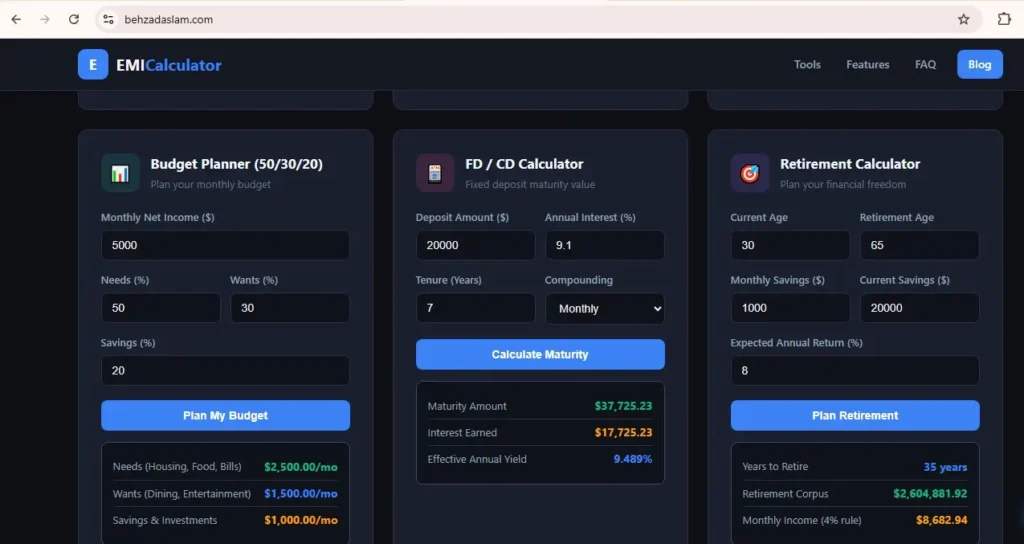
- Deposit Amount
- Annual Interest Rate
- Investment Period
- Compounding Frequency
Click Calculate Maturity to instantly see:
- Final Maturity Value
- Total Interest Earned
- Total Investment Growth
- Investment Summary
Calculator Section
FD / CD Calculator
Enter your deposit amount, annual interest rate, investment period, and compounding frequency to instantly calculate your maturity amount, total interest earned, and final investment value.
Why Fixed Deposits and Certificates of Deposit Are Popular Investments
Fixed Deposits (FDs) and Certificates of Deposit (CDs) are among the most reliable investment options for people who want predictable returns with lower risk than stocks or other market-based investments.
Instead of worrying about daily market fluctuations, your money earns interest at a fixed rate throughout the investment period. This makes FDs and CDs particularly attractive for conservative investors, retirees, and anyone working toward a specific financial goal.
These investments are commonly used for:
- Building emergency savings
- Saving for a home down payment
- Funding children’s education
- Retirement planning
- Wealth preservation
- Short-term investment goals
Because interest rates remain fixed for the agreed period, investors know exactly what their investment is expected to earn before they commit their money.
Who Should Use This FD / CD Calculator?
This calculator is useful for a wide range of investors, including:
| Investor | How This Calculator Helps |
| First-Time Investors | Understand potential investment growth |
| Families | Plan education and emergency savings |
| Retirees | Estimate guaranteed retirement income |
| Professionals | Compare different deposit options |
| Students | Learn how compound interest works |
| Business Owners | Plan secure short-term investments |
FD vs CD: What’s the Difference?
| Fixed Deposit (FD) | Certificate of Deposit (CD) |
| Common in Asia and many international markets | Common in the United States |
| Offered by banks and financial institutions | Offered primarily by banks and credit unions |
| Fixed interest rate | Fixed interest rate |
| Fixed maturity period | Fixed maturity period |
| Early withdrawal may incur penalties | Early withdrawal usually incurs penalties |
| Predictable returns | Predictable returns |
Although the names differ depending on the country, both investment products work in a very similar way by offering guaranteed interest over a fixed investment period.
Start Growing Your Savings Today
Whether you’re planning for retirement, saving for a major purchase, or building financial security, our Free FD / CD Calculator helps you estimate your future investment returns in seconds.
Try the calculator now and compare different investment scenarios before making your next financial decision.
What Is a Fixed Deposit (FD)?
A Fixed Deposit (FD) is a savings investment where you deposit a fixed amount of money with a bank or financial institution for a specific period at a predetermined interest rate. Unlike a regular savings account, the interest rate remains fixed throughout the investment term, providing predictable and stable returns.
Although the term Fixed Deposit (FD) is commonly used in many countries, the United States uses a very similar investment product known as a Certificate of Deposit (CD).
People choose fixed deposits because they offer security, guaranteed returns, and protection from daily market fluctuations. This makes them an excellent option for conservative investors who prioritize capital preservation over high-risk investments.
Common reasons to invest in an FD include:
- Building an emergency fund
- Saving for a home purchase
- Planning for retirement
- Funding education expenses
- Preserving wealth during uncertain markets
Unlike stocks or mutual funds, the return on an FD is generally known before you invest, making financial planning much easier.
What Is a Certificate of Deposit (CD)?
A Certificate of Deposit (CD) is one of the safest savings products offered by banks and credit unions in the United States. It works similarly to a Fixed Deposit by allowing you to invest money for a fixed period in exchange for a guaranteed interest rate.
Most CDs have terms ranging from 3 months to 10 years. In general, longer-term CDs tend to offer higher interest rates, although this depends on market conditions.
One important feature of CDs is that withdrawing your money before the maturity date usually results in an early withdrawal penalty. Therefore, it is important to select a term that matches your financial goals.
Certificates of Deposit are popular among:
- Retirees seeking stable income
- Families saving for future expenses
- Investors reducing portfolio risk
- Individuals building guaranteed savings
When issued by eligible banks, many CDs are protected by federal deposit insurance within applicable limits, providing an additional layer of security.
How FD/CD Interest Works
Interest is the reward you earn for allowing a financial institution to use your deposited money.
With Fixed Deposits and Certificates of Deposit, interest is calculated based on:
- Your initial investment amount
- The annual interest rate
- The investment duration
- The compounding frequency
Compounding plays an important role because it allows previously earned interest to generate additional interest over time. The more frequently interest is compounded, the greater your potential earnings.
For example:
- Annual compounding
- Semi-annual compounding
- Quarterly compounding
- Monthly compounding
- Daily compounding
Although the differences may seem small initially, they become much more noticeable during long-term investments.
Compound Interest Formula
Our FD / CD Calculator uses the standard compound interest formula applied by many financial institutions.
A=P(1+rn)ntA = P\left(1+\frac{r}{n}\right)^{nt}A=P(1+nr)nt
Where:
- A = Final Maturity Value
- P = Initial Deposit
- r = Annual Interest Rate
- n = Number of Compounding Periods Per Year
- t = Investment Duration (Years)
This formula accurately estimates how your investment grows through compound interest over time.
Step-by-Step FD Calculation Example
Imagine you invest:
| Investment Detail | Value |
| Deposit Amount | $10,000 |
| Interest Rate | 5.50% |
| Investment Period | 5 Years |
| Compounding | Quarterly |
After entering these values into the calculator, you instantly receive:
- Estimated maturity value
- Total interest earned
- Overall investment growth
- Complete investment summary
Instead of manually performing complex calculations, the calculator produces reliable results within seconds.
Maturity Value Example
Suppose two investors each deposit $20,000, but they choose different investment periods.
| Investor | Deposit | Years | Estimated Growth |
| Investor A | $20,000 | 3 Years | Moderate Growth |
| Investor B | $20,000 | 7 Years | Higher Growth Through Compounding |
Although both investors begin with the same amount, the investor who leaves the money invested longer generally benefits from greater compound interest growth.
This simple example highlights why time is one of the most valuable factors in investing.
Factors That Affect FD Returns
Several factors influence how much your investment will earn.
Deposit Amount
A larger initial investment generally results in higher interest earnings because interest is calculated on a larger principal.
Interest Rate
Higher annual interest rates naturally increase the total maturity value.
Investment Period
Longer investment terms provide compound interest with more time to grow your savings.
Compounding Frequency
Monthly or quarterly compounding usually generates slightly higher returns than annual compounding.
Early Withdrawal
Withdrawing funds before maturity may reduce your earnings due to penalties or lower interest payments.
Understanding these factors allows you to compare different investment opportunities more effectively.
Tax Considerations (USA CD Basics)
For many U.S. investors, interest earned on a Certificate of Deposit is generally considered taxable income, even if the interest remains in the account until maturity.

Depending on your financial situation, taxes may reduce your overall return.
Because tax laws vary based on income, state regulations, and account type, it is always a good idea to consult a qualified tax professional before making significant investment decisions.
Our calculator estimates investment growth before taxes, helping you compare different savings scenarios quickly and easily.
Common Investment Mistakes
Many investors unintentionally reduce their returns by making avoidable mistakes.
Some of the most common include:
- Choosing the wrong investment term
- Ignoring inflation
- Withdrawing funds early
- Investing without comparing interest rates
- Keeping all savings in one investment product
- Forgetting about taxes on interest earnings
- Focusing only on interest rates instead of overall financial goals
Avoiding these mistakes can significantly improve your long-term financial outcomes.
Smart Investment Tips
Before opening a Fixed Deposit or Certificate of Deposit, consider these practical strategies:
- Compare rates from multiple banks.
- Match the investment term with your financial goals.
- Keep an emergency fund separate from long-term investments.
- Reinvest interest whenever possible to maximize compounding.
- Review current market rates before renewing an FD or CD.
- Diversify your investments rather than relying on a single savings product.
- Monitor inflation to ensure your savings maintain purchasing power.
Small, informed decisions today can make a meaningful difference to your financial future.
Real-Life USA Financial Scenario
Sarah, a 35-year-old marketing professional from Texas, wanted to save for a down payment on her first home within five years. Instead of leaving $25,000 in a regular savings account, she compared several Certificate of Deposit options using an FD / CD Calculator.
After reviewing different interest rates and compounding frequencies, she selected a five-year CD that aligned with her timeline. The calculator helped her estimate the maturity value, understand how compound interest would increase her savings, and confidently choose the option that best supported her home-buying goal.
This planning process gave Sarah a clear savings target and eliminated much of the uncertainty around her future finances.